

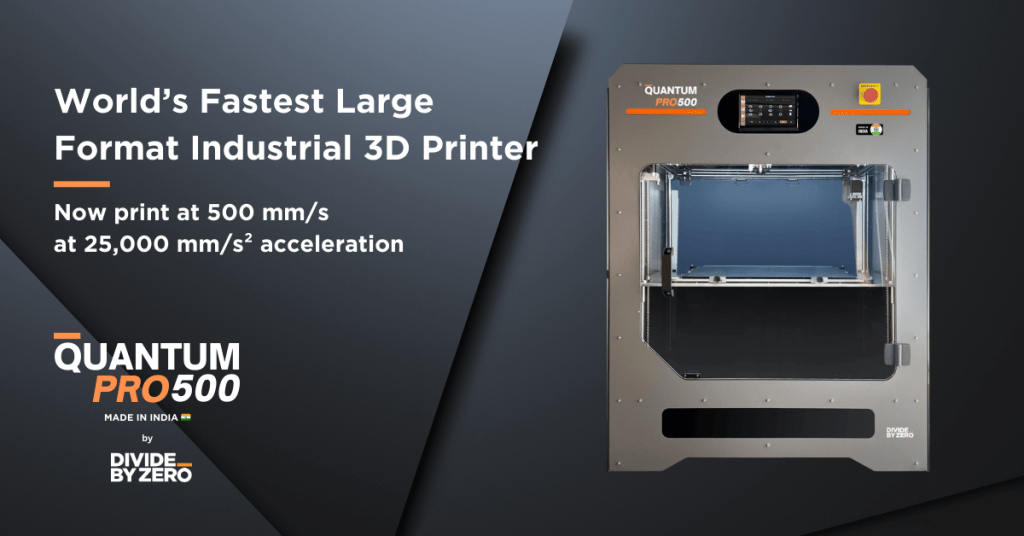
You’ve seen the specs.
“500mm/s print speed.”
“25,000mm/s² acceleration.”
It’s on every other spec sheet now.
So it’s fair to ask — what’s the big deal with Quantum Pro 500?
And we get it. Because on paper, speed is just a number.
Until you scale it. Until you push it to the edge. Until you make it real.
Let us tell you what those numbers really mean — not in theory, but in the real, messy, unpredictable world of industrial 3D printing.
Speed at Small Scale Is Easy. Speed at Scale Is Engineering Warfare.

Most machines that flaunt 500mm/s speeds?
They’re built for compact platforms — 200mm, maybe 300mm max. At that scale, speed is easier to manage. There’s less inertia, minimal vibration, and fewer risks to print integrity.
Now picture this:
A 500mm x 500mm x 500mm machine, moving at 500mm per second, with 2.5G acceleration, printing composite parts with industrial strength and sub-0.1mm accuracy.
That’s not fast.
That’s freaking outrageous.
Because at that scale and speed:
- Every vibration matters. One loose belt? Your part is gone.
- Backlash becomes merciless. If your system isn’t dialed in, precision dies.
- Heat zones stretch out. One inconsistency and your layers start lifting.
- Motion blur isn’t theory anymore. It shows up in every curve, every edge.
And if your extrusion, motion, firmware, and mechanics aren’t dancing perfectly in sync — your beautiful high-speed claim turns into high-speed garbage.
So What Did We Do Differently at Divide By Zero?
We didn’t just aim for “fast.”
We aimed for usable speed — at scale, with strength, and repeatability.
Here’s how Quantum Pro 500 makes that happen:
- Gantry, Reinforced and Rigid: Built to absorb high-speed inertia without compromise. It doesn’t wobble, it doesn’t flex — it owns its movement.
- Advanced Backlash Compensation Algorithms: Fine-tuned to correct deviations at micro levels, ensuring that every corner, arc, and infill line hits precisely where it should.
- Real-time Vibration Control: Our system doesn’t just respond — it anticipates motion disturbances and corrects them mid-print.
- Precision PID Tuning: Controlling not just movement, but extrusion dynamics to prevent under-extrusion, stringing, or inconsistent layers at extreme speeds.
- Composite-Ready at Speed: Carbon fiber, glass-filled nylon — no curling, no weak interlayers, no compromise on strength.
And the Proof? It’s in the Print.
Let’s talk numbers:
- A manifold that used to take 5 hours? Quantum Pro prints it in under 1.5 hours — without a single layer shift.
- A production fixture that once took 10 hours? Done in less than 3 hours, with perfect dimensional accuracy.
- And all of this at ±0.1mm tolerance, layer after layer.
You’re not just printing faster.
You’re printing better, stronger, and more efficiently than ever before.
But Here’s the Twist — We Didn’t Stop at Performance.
You’d expect a machine like this to come with a price tag that makes your CFO nervous.
But Quantum Pro 500 is priced at one-third the cost of the nearest comparable Chinese machine.
Yes. You read that right.
Not just India’s fastest large-format printer.
One of the world’s fastest — at a fraction of the cost.
Why Does This Matter?
Because now, you don’t have to choose between speed and quality.
You don’t have to compromise on size for the sake of performance.
You don’t have to outsource parts that take too long to print in-house.
You don’t have to wait.
With Quantum Pro 500, your ideas become parts — same day.
Your prototypes become production — in real time.
Your business moves at the speed of innovation.
So Yes — 500mm/s is a common claim.
But holding that speed at 500mm build size,
With composite strength,
With ±0.1mm accuracy,
At 3X lower cost —
That’s Quantum Pro.
And once you see it in action,
You’ll wonder how you ever printed any other way.
Book a live demo and experience the speed, strength, and scale of Quantum Pro 500 for yourself.
This isn’t just a 3D printer.
It’s a turning point.