

A Strategic Guide to Industrial Additive Manufacturing for NPD Leaders
Global manufacturing is undergoing a structural shift driven by digital design, localized production, and advanced additive manufacturing.
For New Product Development (NPD) and R&D leaders, traditional barriers such as tooling cost, lead time, and geometric limitations are rapidly dissolving.
However, as additive manufacturing transitions from prototyping to production, system selection has become significantly more complex.
The market is crowded with machines that promise industrial performance but fail to deliver the uptime, repeatability, and material integrity required for real engineering workflows.
The Reality Most Teams Discover Too Late
Common industrial pain points include:
- Overnight print failures
- Poor batch repeatability
- Frequent nozzle clogs
- First-layer inconsistencies
- Excessive operator dependency
In most cases, failures are not material problems. They are system architecture problems.
The Industrial Prosumer Divergence
Prosumer systems are built for intermittent usage, while true industrial platforms are engineered for continuous 24/7 operation.
Divide By Zero systems are specifically designed to bridge this reliability gap and are widely deployed in automotive R&D, tooling, and functional prototyping environments.
Mechanical Architecture: Why It Matters
High-speed FFF printing demands exceptional motion stability. Even minor frame vibration directly impacts dimensional accuracy and surface finish.
The Servo Advantage
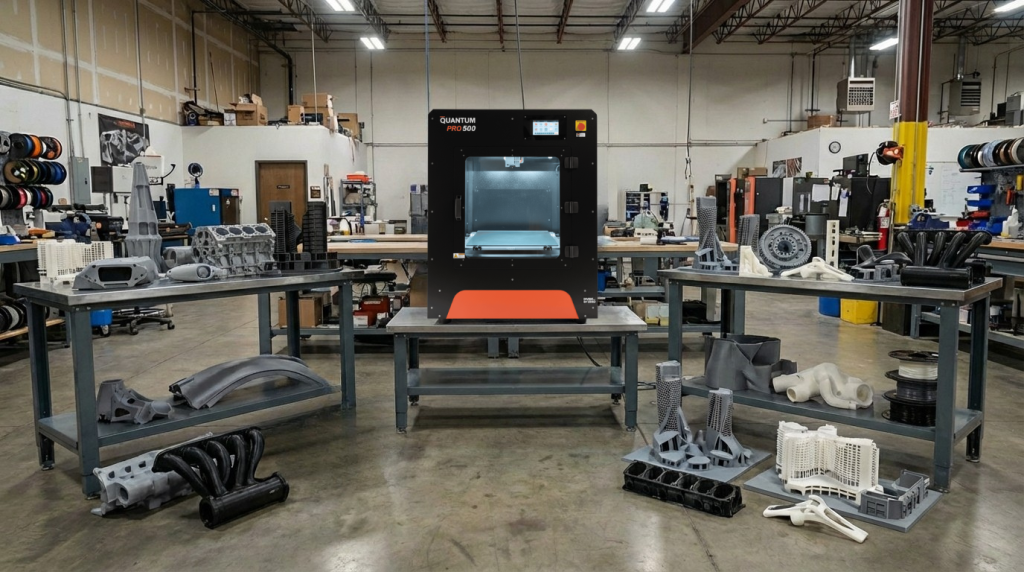
Closed-loop servo systems such as those used in the Quantum Pro series provide real-time position correction, consistent torque at high speeds, and significantly reduced vibration compared to open-loop stepper systems.
Thermal Management and Material Integrity
Engineering polymers require tightly controlled thermal environments. Industrial platforms must provide:
- All-metal high-temperature hotends
- Stable heated beds
- Controlled chamber environments
- Water-cooled extrusion systems
Divide By Zero machines are engineered to handle engineering-grade polymers and composites reliably in production environments.
The Reliability Stack
Industrial uptime depends on automation features including:
- Automatic bed leveling
- Filament flow monitoring
- Clog detection
- Power-loss recovery
- Intelligent calibration
DBZ systems integrate these capabilities to dramatically improve print success rates and enable true lights-out manufacturing.
Total Cost of Ownership (TCO)
Professional teams evaluate cost per successful part, not just machine price.
Hidden costs of unreliable systems include:
- High scrap rates
- Operator babysitting time
- Production delays
- Frequent recalibration
Divide By Zero platforms are optimized to reduce these hidden costs through higher reliability, industrial duty capability, and strong local support in India.
Final Thought
For NPD leaders, additive manufacturing is no longer optional. It is strategic infrastructure.
Organizations that deploy true industrial platforms will accelerate innovation cycles, reduce tooling costs, and build more agile manufacturing workflows.
Divide By Zero continues to position itself at the forefront of India’s industrial additive manufacturing movement by combining high-speed performance, mechanical robustness, and application-driven support.
Testimonials
Hindalco
Hindalco has been using our machine for over three years and reports consistent, reliable performance throughout. They have not faced any operational issues during this period and strongly recommend the system for industrial applications.
Watch the testimonial
Imaginarium
Imaginarium shared that the machine has been reliable for prototyping and has also helped them deliver urgent client projects on tight timelines. They highlighted the robust build quality and user-friendly operation, and noted that both technical and non-technical team members were able to learn it quickly. They also appreciated the wide range of materials the system supports, and use it regularly for jigs and fixtures, medical devices, and functional prototyping.
Watch the testimonial